Everything you need to play Sacrament around a real table, with dice, paper and pencils. Free printables, a ready-to-run adventure and the rules on one page.
Sacrament was first played on the Sacrament RPG Table, in a browser. The rules work just as well on paper. You need one GM, three to five players, a set of dice each, and a few printed sheets. No screens, no accounts.
What to bring
One GM and three to five players. The GM describes the world and plays everyone in it; each player plays one hero.
Dice for each player: a d20 for checks, plus a d4, d6, d8, d10 and d12 for Effort. The d4 also counts down a dying hero's rounds.
Dice for the GM: two d10s for d100 loot rolls, and enough d10s for a Party rest (one for every two heroes).
A character sheet for each hero, and pencils with erasers. HP, charges and Horror go up and down all evening.
The print-and-play kit (below): the quick reference, the Horror track, the Target sign, foe cards, turn slips, countdowns and a healing log.
A coin to mark the Horror, and another to mark the round.
A map and pieces. A printed map or a wipe-clean mat, and miniatures, tokens or coins. No grid is needed: distances are Close, Near, Far and Very Far.
A GM screen or a folder, to hide private rolls, notes and the adventure.
About four hours for The Guest at Greave, in one long session or two shorter ones.
Free printables
Everything here is free to print for your own table. Each PDF comes in A4 and US Letter.
For everyone
Print-and-play kit
Nine sheets: a quick reference, a blank character sheet with a notes page, the Horror track and a fold-up Target sign, foe and obstacle cards, turn slips and countdowns, a healing log, item and grimoire cards, and a what-to-bring checklist.
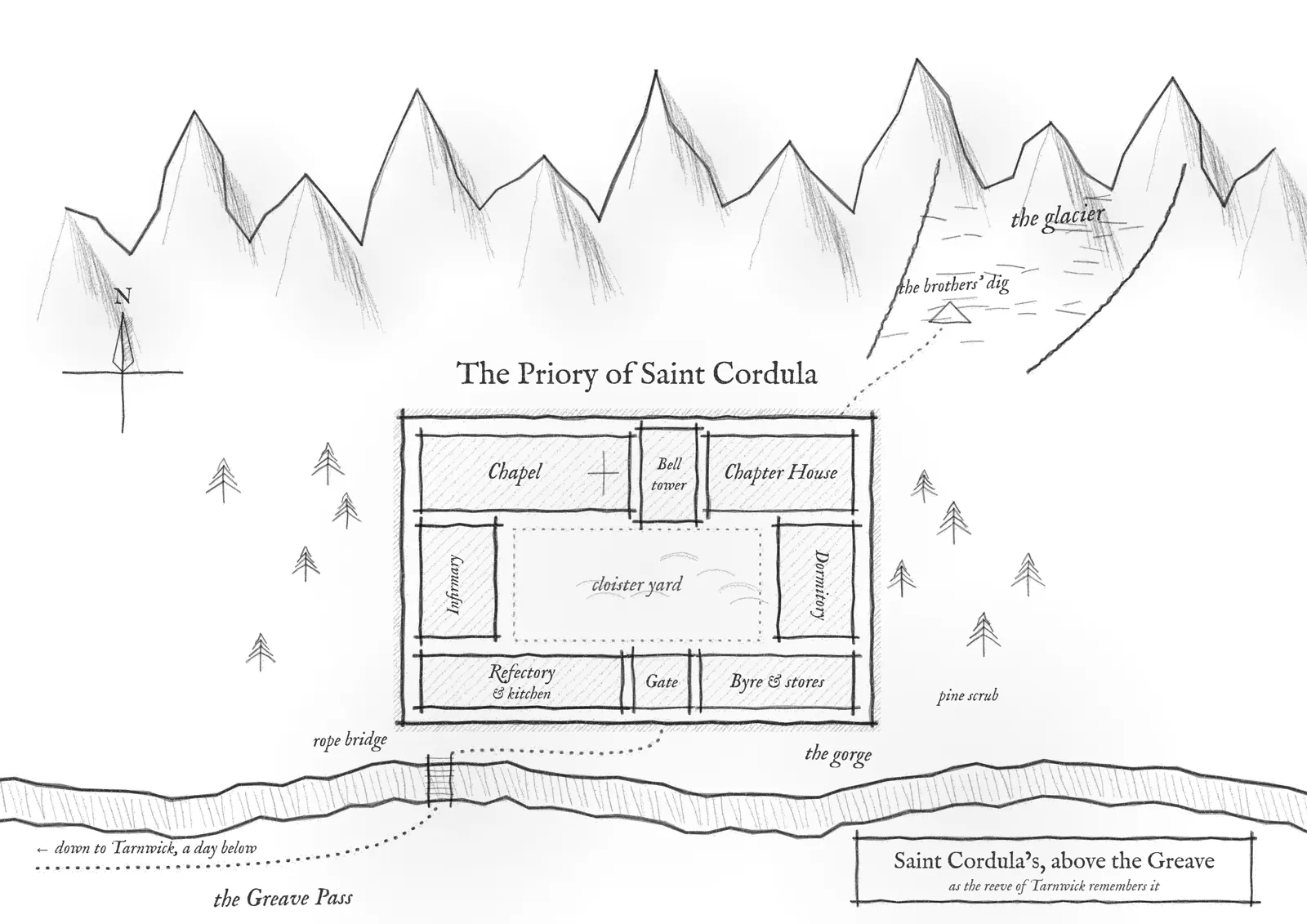
A ready-to-run adventure in five scenes, written for a real table. The heroes carry the winter supplies up to a snowbound priory whose signal fire has gone out, and find eight people they have never met and a question nobody wants to ask out loud. It is for three to five starting heroes and takes about four hours. The fights are short; the real game is who you would trust to hold the lamp.
The adventure and its audio are for the GM only: they tell you who the monster is. Players get the opening reading and the map.
For the GM
The Guest at Greave
The full adventure: the priory and its people, five scenes, the monster and how to run the suspicion. Read it online or print all 20 pages.
The opening reading: the world as the Church tells it, the village of Tarnwick, and the fire that did not burn. One player reads it aloud before the first scene. No spoilers.
Make a hero. Open My heroes, press Generate a hero, then Print or save as PDF to get a filled-in character sheet. Or copy your numbers onto the blank sheet in the print-and-play kit.
Print the player cheat sheet, or read it once on your phone. It covers checks, Effort, Push, the Horror, healing and dying.
Do not read the adventure. If your GM runs The Guest at Greave, the only part meant for players is the opening reading, Before the Snow.
The GM
Print the print-and-play kit. Sheet 9 is a checklist of everything else to bring.
Read the adventure all the way through, and listen to the narrated version if it helps.
Prepare the foe and obstacle cards for the first scene, and keep them face down until the heroes find them.
Print the Current Loot Tables page, or keep it open on a phone. You roll on it when the heroes search.
Decide the house rules and tell the players before you start: whether a natural 20 adds an Ultimate die, and whether scene danger adds to monster attacks. Both are optional.
Who keeps track of what
The Sacrament RPG Table quietly does the bookkeeping. Around a real table, people do it instead.
The job
Who does it at a real table
Adding up checks against the Target
The player says the total; the GM confirms it
Taking damage off HP, or adding progress to an obstacle
The GM crosses boxes on the foe card; players erase their own HP
Adding Horror for spells, items, natural 1s and Pushes
Whoever caused it moves the coin on the Horror track
Paying in blood past 21
The hero who caused it rolls d4 for each point and loses that HP
Remembering who has had which healing since the last rest
The healing log in the kit
Ticking countdowns and dying heroes each round
The GM, each time the round coin moves
Rolling loot
The GM, with the printed loot tables
Keeping hidden foes and GM notes secret
Face-down cards and the GM screen
Undo
An eraser, and an honest table
The rules at a glance
Checks: roll d20 and add your score. Meet or beat the Target to succeed. Easy lowers the Target by 3; Hard raises it by 3.
Effort: after a success, when the amount matters, roll the Effort die for what you used and add your Effort bonus. Ordinary weapons, bows and crossbows use d6; guns use d8; damaging magic uses d10.
Defence: 10 + CON + armour. A monster rolls d20 + its attack bonus against it. A monster's natural 1 always misses and its natural 20 always hits.
Hearts: 10 HP to a Heart. At 0 HP a hero is dying and rolls a d4 for the rounds they have left.
Push: after a failed attack, once, on your own turn. It costs 1 Horror and gives you an immediate second action, which cannot be pushed.
The Horror: one shared track from 0 to 21. Every spell except healing adds 1. Items add their listed cost. A Push adds 1. A hero's natural 1 adds 1 more on an attack, a spell or a pushed action, but not on other checks. At 7, 14 and 21 the GM decides what happens. Past 21 you pay in blood: each point that cannot go on the track costs the hero who caused it d4 HP.
Party rest: when the GM allows it, each living hero heals 10 HP and the Horror falls by d10 for every two living heroes, rounded up.
The Player guide and GM guide have the full rules. They describe the buttons of the online table, but the numbers are the same on paper. The rules are still being playtested: check Rules updates and errata before you print, and correct older printouts by hand.
Tell us how it went
The Guest at Greave is our first test of Sacrament around a real table. If you run it, we would like to hear what worked, which numbers people forgot, and anything you had to make up on the spot. Use the feedback page. It takes a minute and asks for no contact details.